
Product data sheet
Operation and maintenance
Shade Lab
LUBE INDUSTRIES Srl Via dell’industria, 4 - Treia (MC) - Italy
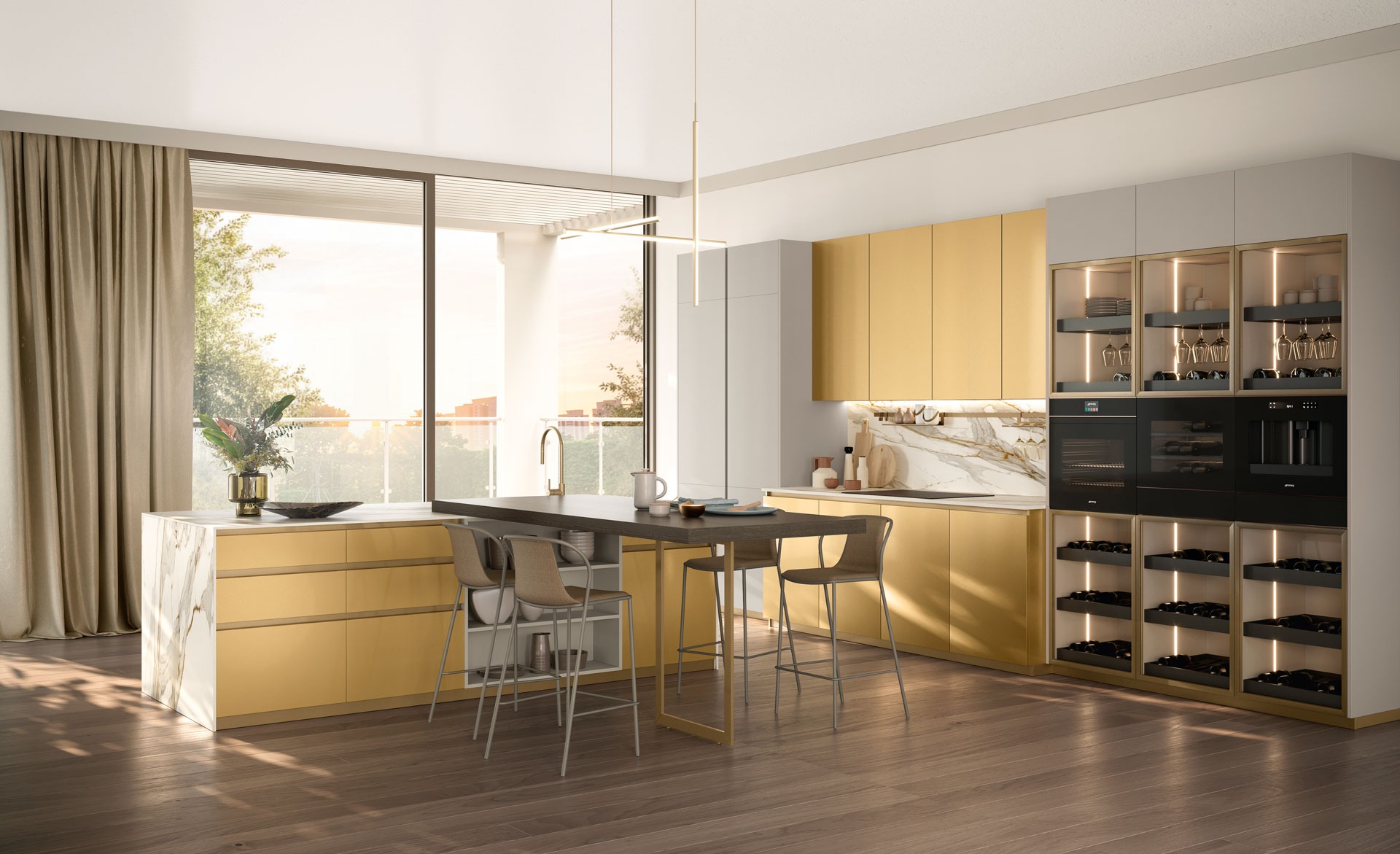
SHADE Lab kitchen furniture model.
This product sheet complies with the provisions of Legislative Decree No. 206 of September 6, 2005 "Consumer Code".
Door, 22 mm thick, consisting of an MDF wood fiber panel (compliant with US EPA TSCA Title VI), matte lacquered or brushed glossy lacquered.
Applied to the front of the door, horizontal or vertical.
Door panel 22 mm thick made of an MDF wood-fibre panel (compliant with US EPA TSCA Title VI), edged and finished in ultra-matte lacquer with excimer technology*. The back is lacquered in matching color with a 10-gloss micro-textured finish and a slightly embossed surface.
*The new super-matte excimer finish makes it possible to have lacquered panels at 0 gloss while maintaining high technical performance: total opacity, anti-reflection, fingerprint resistance, and scratch resistance.
Applied to the front of the door, horizontal or vertical.
Door panel 22 mm thick made of MDF wood fibre board (compliant with US EPA TSCA Title VI), lacquered with a pearlescent finish.
The finish combines the elegance of matte with a touch of sophisticated luminosity. The extra-matte paint, enriched with pearl microspheres, creates a pearlescent effect that gently reveals itself in the light and feels velvety to the touch.
The Pearl effect surfaces require careful maintenance, especially during the product cleaning stage. The use of mild detergents is recommended so as not to damage or compromise the painted surface finish.
Applied to the front of the door, horizontal or vertical.
Cabinet door, 22 mm thick, made of MDF wood fibre panel (conforming to US EPA TSCA Title VI), lacquered with a textured effect.
The finish is designed to replicate the scratched steel sheet in a light-dark tonal variation.
The scratching is shallow and smooth to the touch. The black satin finish runs horizontally and vertically. After the drying phase, the product is antiqued with a special product, manually worked so as to ensure a streaked effect on the surface and edge of the panel.
Textured-effect surfaces require careful maintenance, especially during the product cleaning phase. It is recommended to use mild detergents that do not damage or compromise the painted finish.
Applied frontally to the door, horizontal or vertical.
Door panel 22 mm thick, made of an MDF wood fiber panel (compliant with US EPA TSCA Title VI) lacquered with a vintage metal-effect finish.
The finish is created through an initial primer application stage, onto which the VINTAGE-effect paint is then applied. After an initial drying phase, the door undergoes a series of manual surface treatments, which produce the effect of aged metal sheet.
The surface shows no evident scratches, ensuring a clean product with no pronounced marks.
Metal-effect surfaces require careful care, especially when cleaning the product. The use of mild detergents is recommended so as not to damage or compromise the painted finish.
Applied frontally to the door, horizontal or vertical.
Door panel 22 mm thick made of MDF wood fiber board (compliant with US EPA TSCA Title VI) lacquered with a semi-gloss vintage brushed-effect finish.
The finish is designed to replicate the typical satin finish of stainless steel sheets through small mechanically applied scratches, which allow the surface to appear blurred while reflecting in the same direction as the satin finish.
Brushed-effect surfaces require careful maintenance, especially during the product cleaning phase. The use of mild detergents is recommended so as not to damage or compromise the painted surface finish.
Applied frontally to the door, horizontal or vertical.
Cabinet door, 22 mm thick, made of MDF wood fiber panel (compliant with US EPA TSCA Title VI), lacquered with oxidized liquid metal.
The finish is created through an initial primer application phase, on which the paint is subsequently applied, followed by a series of manual surface treatments that recreate the effect of oxidized sheet metal.
This type of effect is enhanced by the black circular stains (more pronounced than the VINTAGE METAL EFFECT finish) randomly and unevenly distributed on the surface, testifying to an accentuated manual aesthetic processing across the entire surface of the panel.
The edges are circularly scratched and stained by the decorator, in an effort to ensure a continuous surface even on the side of the panel.
The metal-effect surfaces require careful care, especially when cleaning the product. The use of mild detergents that do not damage or compromise the painted surface finish is recommended.
Applied frontally to the door, horizontal or vertical.
Door, 22 mm thick, made of a panel composed of wood particleboard (compliant with US EPA TSCA Title VI), with external front in super-matt lacquer (3 gloss with excimer treatment) or high-gloss (95 gloss), UV coating cycle, edged on 4 sides in PP (polypropylene), door back matched in color.
Applied frontally to the door, horizontal or vertical.
Door front, 22 mm thick, made of a panel consisting of wood particleboard (compliant with US EPA TSCA Title VI) with an exterior front in super-matt lacquer (3 gloss, excimer-treated) or extra-gloss (95 gloss), UV varnishing cycle, edged on 4 sides with two-tone PMMA edging with a two-tone finish, titanium and matching the front of the door front. The back of the door front matches the front.
Applied frontally to the door, horizontal or vertical.
Door panel, 22 mm thick, made of an MDF wood fiber panel (compliant with US EPA TSCA Title VI), with an external front in marble-effect melamine and coated with transparent glossy UV varnish, edged on all 4 sides with a two-tone PMMA edge in titanium finish, rear side matching the door color.
Applied frontally to the door, horizontal or vertical.
Door, 22 mm thick, made of an MDF wood fiber panel (compliant with US PA TSCA Title VI) with a glossy metallic lacquered exterior face, edged on 4 sides with PP edging.
Applied frontally to the door, horizontal or vertical.
The finishes of the SHADE LAB model identified as Special Lacquered (PEARL EFFECT – TEXTURED EFFECT – VINTAGE METAL EFFECT – VINTAGE BRUSHED EFFECT – OXIDIZED LIQUID METAL) are the result of an artisanal process, carried out manually by specialized decorators. After an initial painting phase, specific treatments are applied to create a unique and refined effect. Depending on the chosen finish, the processing phase may blend or spread the coating texture across the flat surface or along the edges. The more or less pronounced surface effects therefore represent an intrinsic characteristic of the product, making each piece unique and exclusive.
The presence of any discoloration (e.g. spots, light/dark areas, scratches, and irregularities of various kinds, etc.) should not be considered a defect, but rather a guarantee of a handmade product. Likewise, color variations, especially following the addition of new elements to an already installed kitchen or any replacements, are part of the natural characteristics of the product*.
Therefore, these peculiarities cannot be grounds for complaint.
* In the event of defects along the edges of the doors (small chips or paint defects), it is preferable to assess, if possible, repairing the defect rather than replacing the component.
Consisting of 18 mm thick melamine-faced chipboard panels in accordance with the US EPA TSCA Title VI standard (with very low formaldehyde emission).The shelves are 18 mm thick and equipped with built-in shelf supports with locking device. They can also be made of tempered glass (6 mm thick), grounded on the edges.
Edge in ABS or Polypropylene (PP) glued with thermosetting polyurethane glues 1 mm thick on the front parts of the unit sides and shelves and 0.5 mm thick on the lower and upper parts of the unit sides and on the sides and rear part of the internal shelves. Made of paper for the non-visible parts of furniture (back).
Consisting of 2.8 mm thick high-density fibre panels compliant with E1 and US EPA TSCA Title VI for formaldehyde emissions, wall units with polypropylene veneers and painted bases and columns.
Laminate worktop: 38 or 58 mm thick water-repellent wood particle board coated with high pressure laminate (HPL). For worktops in other materials, please refer to the "Useful information" section.
In sheet 18/10 stainless steel made using a single-casting or electrically welded tubs, with a smooth or "embossed" finish. For sinks in other materials, please refer to the "Useful information" section.
Faced bracket: melamine faced wood particle board panel (class E1); ABS edging.Veneered bracket: wood particle board panel (class E1) veneered with "slices" of wood (which vary depending on the model) and lacquered using acrylic/polyurethane products.
In pine wood or MDF (class E1) veneered with "slices" of wood (which vary depending on the model); acrylic/polyurethane lacquering.
In chequered aluminium or lacquered plastic to protect the sink unit from water seepage.
In knock-resistant plastic material (PVC) and height-adjustable, these are screwed to the bottom of the cabinet using special bushing, without requiring any drilling in the lower part of the casing (thus completely avoiding the creation of areas in which dirt may accumulate or through which water could leak into the base and sink cabinets).They are also available in aluminium and can be adjusted and mounted on a special base structure (also made using an aluminium profile).
These elements may be made using anodised or lacquered aluminium, or PVC coated with decorative melamine foil, and have a rubber seal at the top and bottom.
In rigid plastic material (PVC), drilled in the centre to allow any leaking water to escape and to protect the main cabinet column.
In aluminium or rigid knock-resistant PVC with laminate decoration.
In sheet steel and zamak alloy, copper-plated and nickel-plated for resistance to corrosion; adjustable in three directions.
The structure may consist of a 16 mm thick wood particle base (extremely low formaldehyde emission) faced in grey laminate with side and back panels in galvanised and lacquered sheet steel for protection against corrosion. Alternatively the structure can be made entirely of solid ash and plywood; sliding takes place by means of total extraction runners with a grooved system for anti-detachment locking and automatic closure which is activated in the final 4 cm. The soft-close system (blu-motion) is also supplied as standard.
In electrically welded metal wire; they may be plasticised with polymer resin, nickel-plated or chrome-plated and coated with a transparent plastic sheath (Crominox finish).
Top: may be a wood particle panel (class E1) coated with HPL plastic laminate (see laminate worktop) or veneered with "slices" of wood and lacquered with water-based, polyurethane or acrylic shades, or it may be made using glass, granite or natural stone.Borders and base structure: these may be made using metal or plywood panels, faced or veneered with "slices" of wood (these vary depending on the model).Legs: these may be made using metal or solid wood; lacquering is carried out using acrylic/polyurethane products.
Structure: this may be in tubular metal lacquered with thermosetting powders, or in solid wood lacquered using water-based (impregnating) and acrylic/polyurethane products (base).Seat and Backrest: these may be made using synthetic material (methacrylate), solid wood, plywood, upholstered fabric or simulated wicker.
Note: each type of chair or table is identified at the site of purchase by the relevant adhesive label on the packaging.For further information, please check the user and maintenance manual provided by GRUPPO LUBE.
For further information, please check the user and maintenance manual provided by GRUPPO LUBE.